
In our recently submitted paper, we model how biased individuals evolve their relative opinions on various topics (e.g. their trust in/attention to various media sources) based on interactions in a social network. Our model builds on empirical work that, for example, shows that polarization and echo chambers do arise, but that a diverse community can mediate biases and be more aligned in their opinions.
The model we suggest is a novel multidimensional, nonlinear model, where opinions evolve on a simplex (in order words, the relative opinions on the various options sum to 1). Each agent has an individual fixed bias, which determines what neighbors it will adapt more to. The opinions can escape the convex hull of initial opinions, thereby capturing a radicalization that can arise in echo chambers, but in special configurations our model reduces to a simple consensus model.

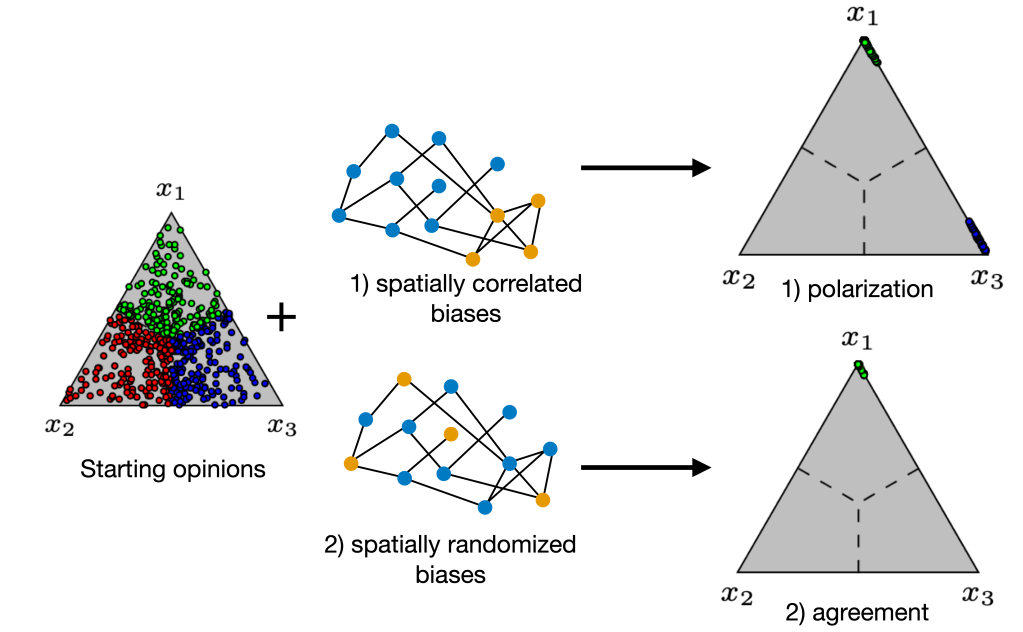
In simulations we show the empirically relevant outcome that a spatial correlation in biases in the network can lead to polarization, while if the same biased individuals are spread out in a diverse network, opinions are more centered. See the image depicting a simulation of a 500-agent Watts Strogatz network.
The work has been done by my PhD student Luka Bakovic, in collaboration with my other PhD student David Ohlin, Prof. Giacomo Como and myself.

 Emma Tegling